Impressions of Seattle is a collection of twelve original oil paintings that celebrates the enduring spirit of one of America’s most distinctive cities. Rather than documenting Seattle with photographic precision, these paintings seek to capture its atmosphere—those fleeting moments of light, memory, and emotion that linger long after a place has been visited. Each composition offers a poetic interpretation of the city, inviting the viewer to experience Seattle through a lens of nostalgia and imagination.
Read MoreLandscapes of Washington State
The landscapes of Washington State unfold like a painter’s dream—vast, diverse, and endlessly dramatic. Nature here reveals both grandeur and intimacy.
We have it all in Washington State. We have oceans and rivers, grand mountain ranges, and volcanos! We have canyons carved by glacial activity of millennium ago. The agricultural produce is bountiful and grown in various climates in the state, climates created by the two mountain ranges, the Olympics and the Cascades that provide ideal conditions for a range of produce.

The Tale of the Two Victors
For the past few days, I have been listening to documentaries on the historic renovation of the cathedral. In so doing, I am struck by similarities that exist between the plight of Notre-Dame de Paris and our own Pike Place Market. To learn more, I will explain. when you read the blog. In this tale, it is the two Victors: Victor Hugo and Notre-Dame de Paris and Victor Steinbrueck and the Pike Place Market who made a positive difference with similarities of purpose.
Read More
Pike Place Market - The Soul of the City of Seattle
We can experience a very old part of Seattle by visiting the Pike Place Market first opened in 1907. Most of its collection of interconnected buildings were constructed by 1929. They haven't changed a bit. They still serve the same function: to host farmers to sell their wares.
Read More
Seattle's Parks and Boulevards - An Olmsted Brothers Legacy
At the turn of the 20th century, Seattle, founded in 1885, was a city that was going on 15 years old. Young Seattle was growing at a fast clip, showing no signs of slowing down. Early Seattle leaders had the foresight to conserve land for the purpose of current as well as future generations to enjoy. Fortunately, these leaders decided to create a parks system in Seattle. They hired notable landscape architects, the Olmsted Brothers, Frederick Law Olmsted, Jr., and John Charles Olmsted to develop the master plans for Seattle’s nascent parks system.
Read More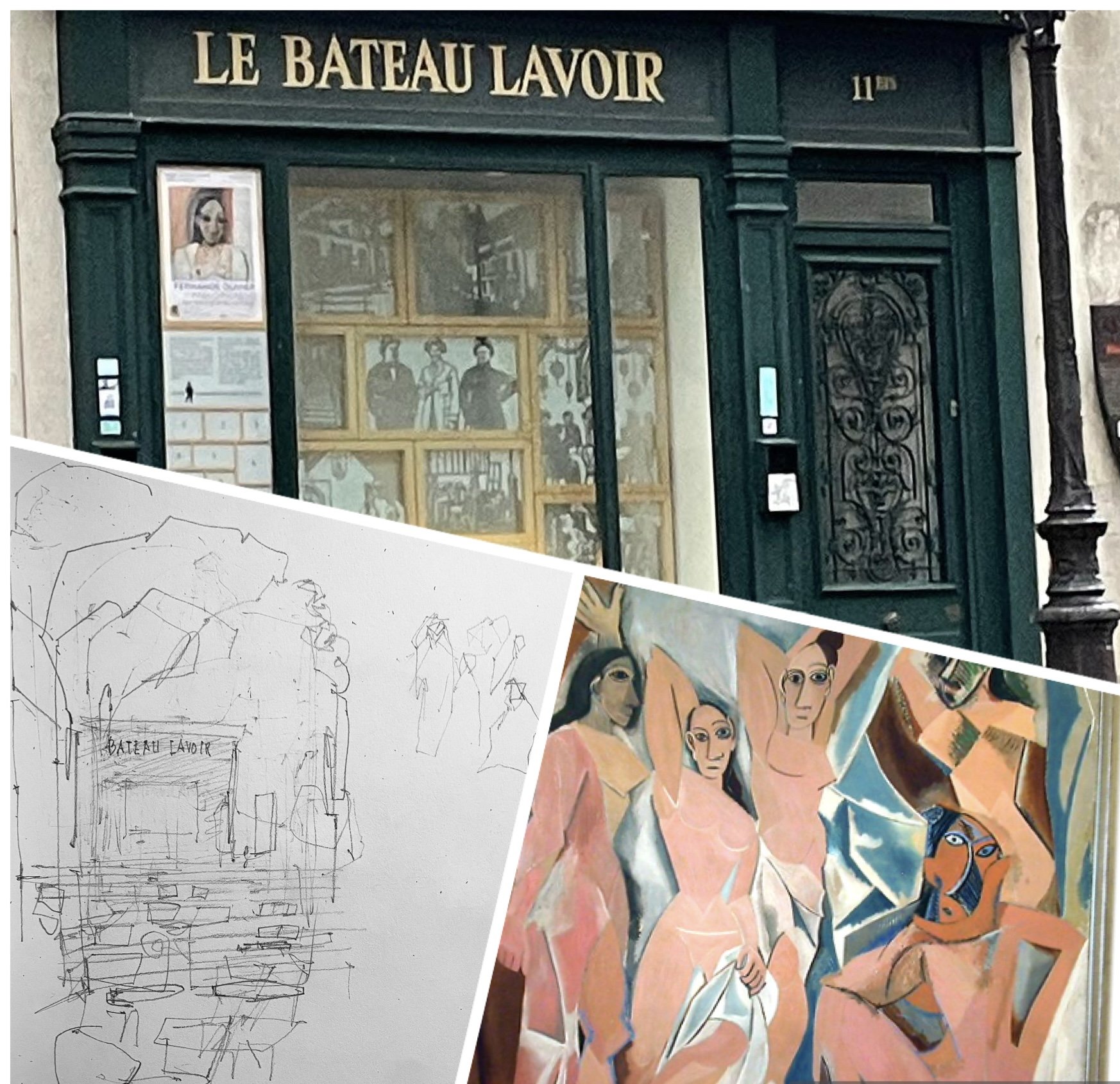
Le Bateau Lavoir, Montmartre. Le Bateau Lavoir is where Pablo Picasso painted his historic painting “Les Desmoiselles d’Avignon,” in 1907 which is now housed at the Museum of Modern Art (MOMA) in NYC. October 2022.
Montmartre
Once its own little village, on January 1, 1860, Montmartre was annexed to the city of Paris with other communities under the modernization and remaking of Paris, Paris the City of Light, Paris the world knows today, under the influence and guidance of Baron Haussmann. Montmartre continues to be a bustling neighborhood that sits high above the city of Paris on a butte where its history of vibrant cafes, theatre, and restaurants still delight.
Read More
Sacré Cœur de Montmartre.
Watercolor on postcard, 4x6.” 2022.
Happenstance-Sunday Mass at Sacré Coeur de Montmartre
Making art gives me a passport, if you will, to travel and to experience, to document my impressions, and to connect with others and foster friendships. During my recent trip to Paris, I had many happenstance opportunities to make meaningful, if only brief, connections that added to the flavor, the texture, the moments of my travel experience. One such happenstance opportunity was when I wandered into Sacré Cœur de Montmartre one Sunday evening.
Read More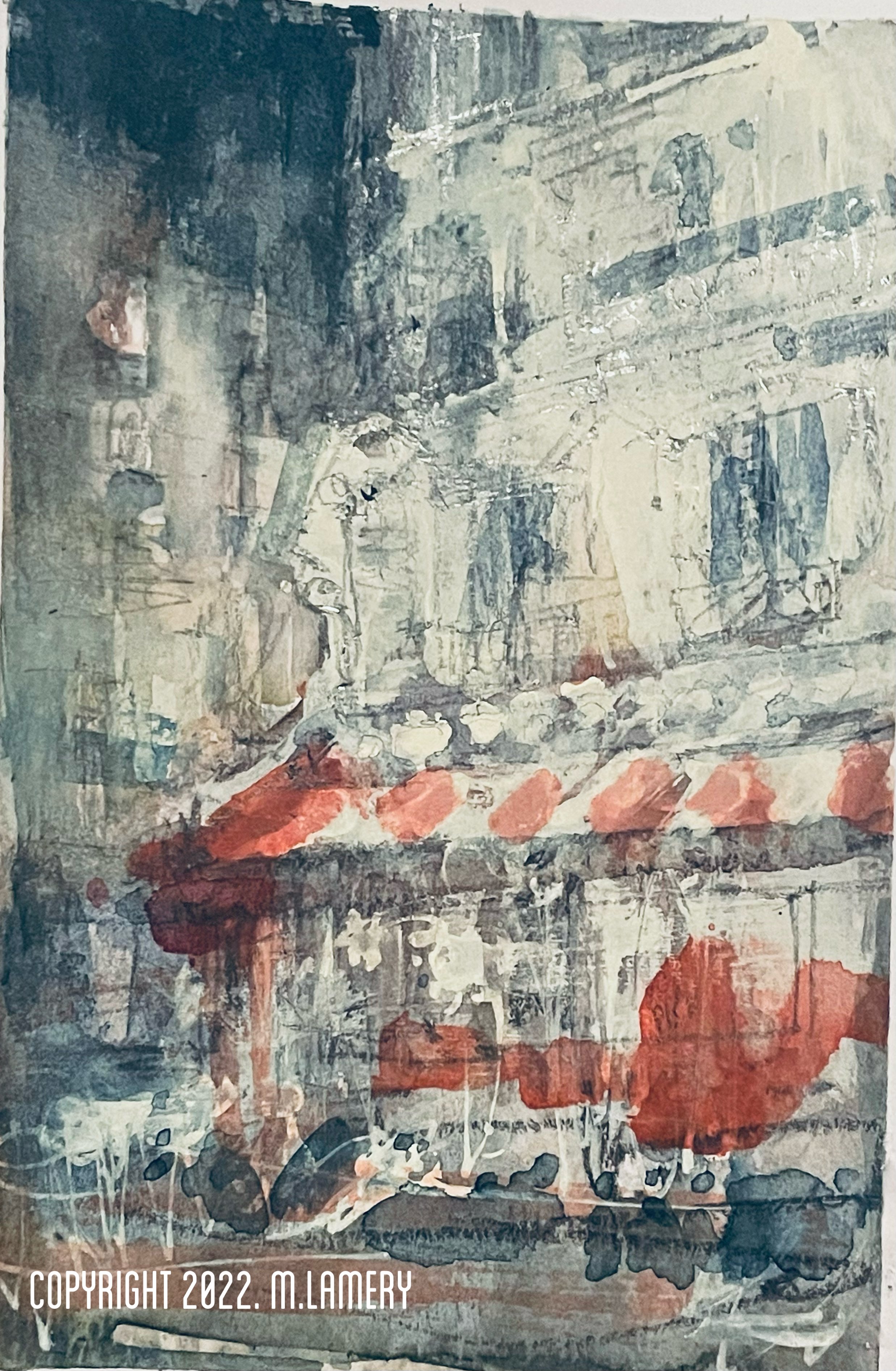
“Evening Cafe, Montmartre, Paris, France.”
Watercolor on paper, 4x6.” 2022.
Vincent and Monique
During my visit to Paris in June, I met a charming older couple, Vincent and Monique, in the Montmartre neighborhood. It all occurred during a chance encounter late one evening as we were all exiting the Paris Metro.
What ensued was a conversation between people from three different countries and an invitation.
Read More
“The Composition Student.” Composite images: Drawing and Painting. Graphite, oil. 15x15.: Work in Progress. 2022.
Becoming a Painting
Becoming a painting - often begins with a drawing or a quick sketch.
In preparation for a show of new work called “Painted Drawings,” I am experimenting with a new approach to my work. I am relying almost exclusively on two elements: my original drawings and my memory.
Read More
University of Washington School of Music. Charcoal sketch on canvas. 30x40.” Work in progress for showing of new work, May 2022.
Painted Drawings
As I prepare for a new showing of work that is to result from a four month artist residency, I realized that my backlog of drawings are the perfect source for me of which to create new work.
Read More
The Inspiring, Incredible, Off-the-Charts Fabulous!
1962 Seattle World's Fair
Watercolor: Space Needle, Coliseum, Science Pavilion. 2021.
1962 Seattle World's Fair
2022 will mark the 60th anniversary of the 1962 Seattle World's Fair. This spectacular event attracted over 10 million visitors during the six months it was open from April 21-October 21, 1962. The World’s Fair provided Seattle with an iconic landmark, the Space Needle. It gave the world a vision of the future. In its wake, it left the City of Seattle with major infrastructure serving as a cultural nexus to this day. I find the fair incredibly inspirational for the times in which we now live.
Read More
Watercolor. World Trade Center. 2001. ML.
The Architect of the World Trade Center - Minoru Yamasaki
I was absolutely bowled over to learn that the person who designed the World Trade Center was the same architect of three well-known buildings in my hometown of Seattle.
Read More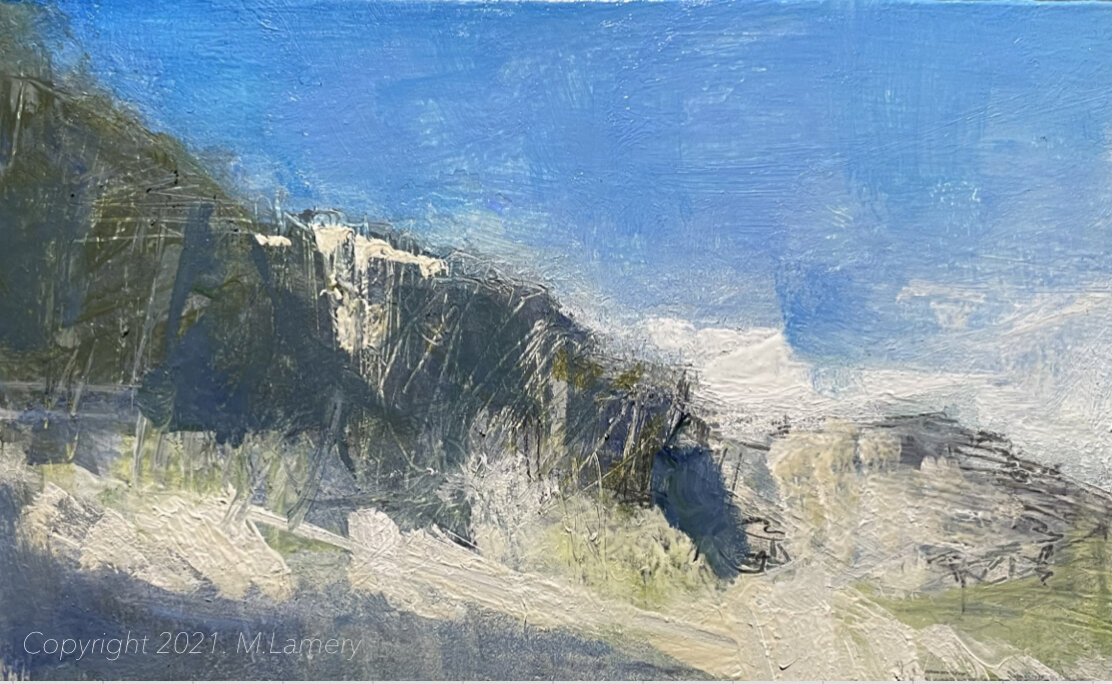
Cowiche Canyon
My mom grew up in the Naches Heights in the midst of apple and cherry orchards, a few miles from the Cowiche Canyon.
Read More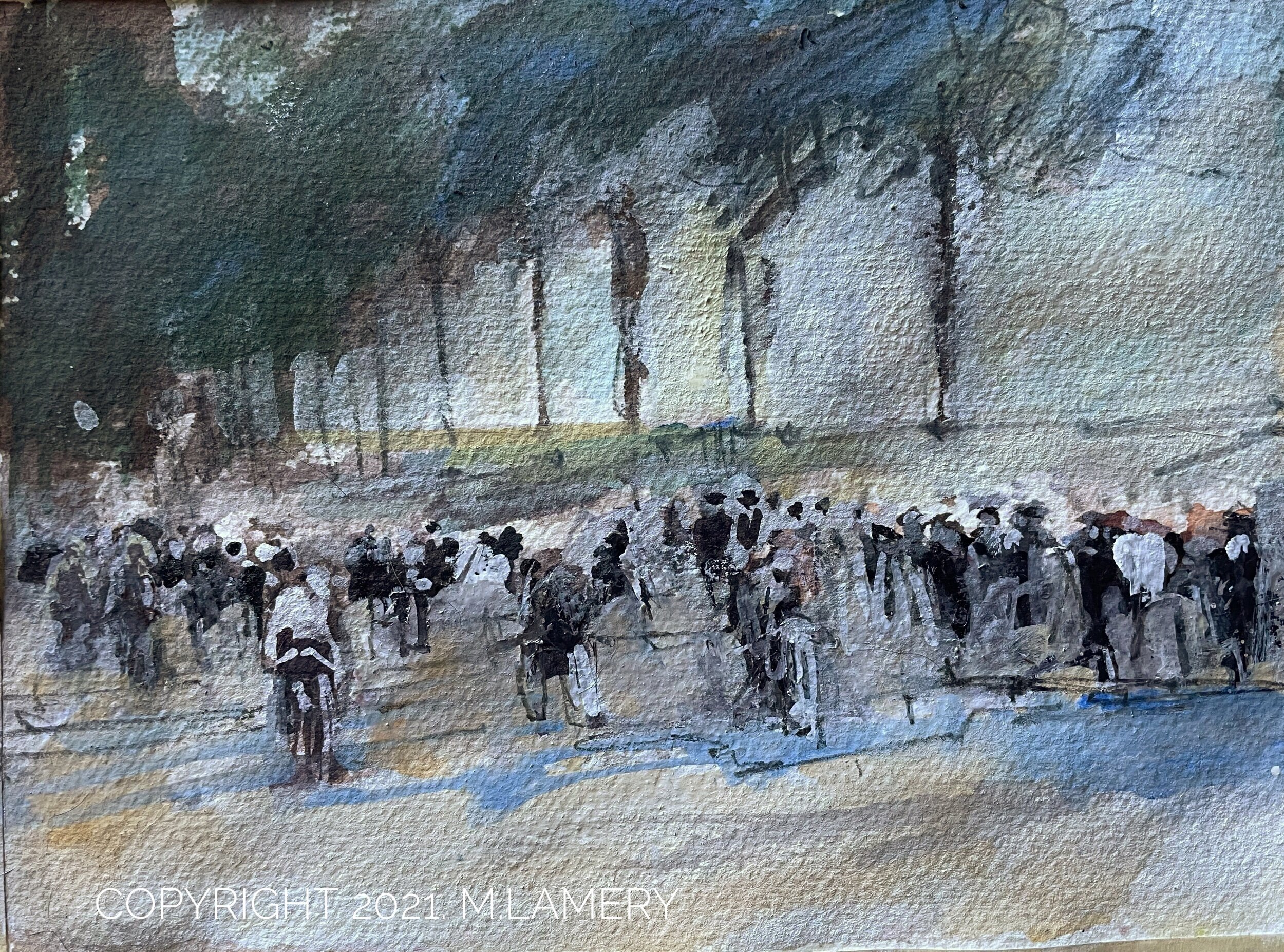
Tour de France
The first Tour de France was in 1903. It was an exciting event even at its inception. The first tour had 60 cyclists, was 17 days long, 1500 miles, and set up into six stages: from Paris to Lyon, Marseille, Toulouse, Bordeaux and Nantes before returning to the French capital.
The Tour de France is also live theatre portraying human potential in the thrill of victory and in some cases truly sad loss of life of that potential along its strenuous course; and of human pathos of the agony of defeat and disqualification.
Read MoreGreen
Seattle is called the Emerald City for a reason.
Everything right now outdoors is green. Lush green. Several nature palettes of lush green. Chlorophyll filled green.
Read More
Yoshino Cherry Trees, Quadrangle, University of Washington. April 2021.
Cherry Trees along the Quadrangle
The season of the cherry blossoms is brief. Only about four weeks. But they are magical days. Whatever is the secret or magical power of these trees to lull so many people to frolic in their presence, I don't know. But there is something magnetic about the trees, and probably the Quad too.
Read More
Musique
As drawing is integral to my life beginning at a very young age, so is playing music. My first musical instrument I learned to play is the guitar. I still have my first guitar given to my as a Christmas present by an uncle when I was 7 years old. I play this guitar to this very day.
Read More
Work in Progress. Oil sketch, Volunteer Park. View from south lily pad pond looking north. “Black Sun” is on the right. Oil on Canvas, 8x10.” 2021. I have the painting sitting in an antique frame for now.
A Sense of Place
I made a few sketches of an area of the park in front of the Seattle Asian Art Museum where there are two ponds of lily pads. Towering above in the center, the monumental "Black Sun" black granite sculpture created in 1969 by Japanese/American sculptor Isamu Noguchi.
Read More
The Flâneur
The concept of the flâneur was coined in the late 19th century and originated as a work of fiction from the mind of 19th century poet and writer, Charles Baudelaire, who introduced the concept in his 1863 essay, "The Painter of Modern Life" (Le Peintre de la Vie Moderne.) At its essence, a flâneur is a detached observer of modern life.
The flâneur may be a concept from another era and another century but it has direct relevance to being in the "now."
Read More
“Terrace Overlook,” Kubota Garden. Oil on Canvas, 4x4.” 2018.
This is a painting of the Terrace Overlook one of the first settings you encounter before you descend down the path into the rest of the garden. The Terrace Overlook was built on ishigaki (stone wall) by Japanese masons from Anoh-shu in 2014.
Kubota Garden, A City Treasure
One of the tenets of traditional Japanese garden design, bridges "are privileged sites in a Japanese garden, where one will linger and take in the beauty of the landscape, watch the carps swimming in their watery elements, and enjoy the softness of the breeze. Bridges may be built of wood, bamboo, earth or stone. Whether they are rounded, arc-shaped or in zigzags, they always remain in harmony with the surrounding nature."
Kubota Garden is one of those cherished sites in the City of Seattle.
Read More